
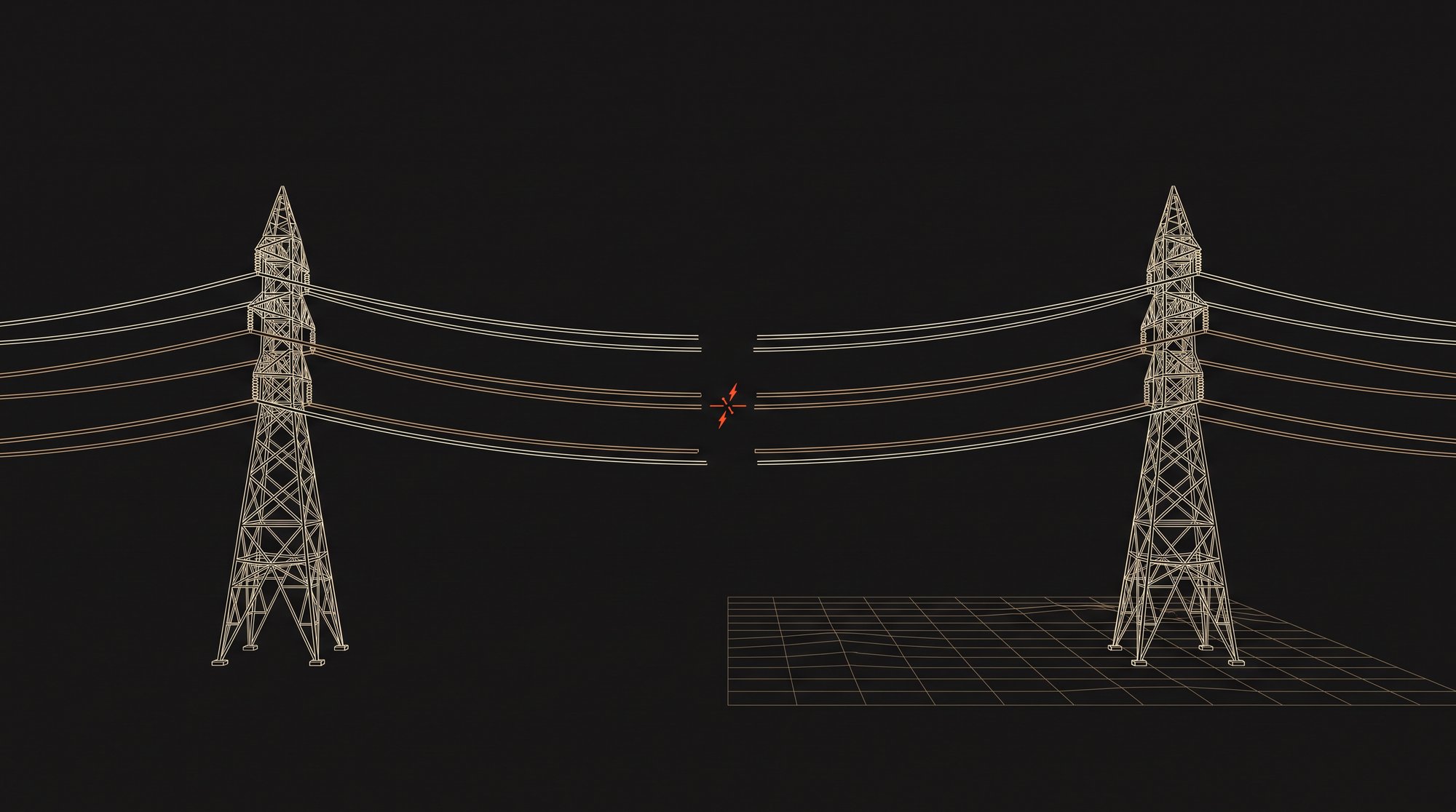
Sometime in the dark hours of May 4, 1976, a technician working for Central and South West Corporation walked into a substation in Vernon, Texas, and flipped a switch. Electricity flowed north into Altus, Oklahoma. It flowed for a few hours. Then it stopped.
This was not a maintenance error. It was an ambush.
For decades, the utilities of Texas had maintained an arrangement of almost theological seriousness: no electron shall cross the state line. The reasoning was elegant and entirely self-interested. The Federal Power Act reaches interstate commerce. Keep the power inside Texas and there is no interstate commerce to reach. During the Second World War, Texas utilities had knitted themselves into a single statewide machine to serve the war factories and, in doing so, proved a thing nobody had bothered to prove before: an economy the size of a nation can run on an island of its own making, thank you very much, and Washington need not be consulted.
CSW, for reasons involving its own Oklahoma subsidiary and the ordinary commercial spite that animates most utility litigation, decided to blow the arrangement up. If Texas power flowed into Oklahoma, Texas power was interstate. If Texas power was interstate, every utility in the state had just been dragged, unwillingly and unwittingly, under federal jurisdiction.
The response was immediate and, we would argue, extremely Texan. Houston Lighting & Power and Texas Utilities did not file a brief. They physically severed their transmission ties to CSW, at meaningful risk to the stability of the entire state grid, on the theory that it was better to risk the lights than to catch what Judge Richard Cudahy would later call the “irrevocable taint of interstate power.”
The litigation ran for years. Texas won. The judge and historian Richard Cudahy would eventually write the definitive account of the episode and give it the only title it could possibly have borne: The Second Battle of the Alamo.
We rehearse this history not out of antiquarian affection, but because the state of Texas is currently in the process of doing the exact same thing to its data centers, and the data centers, to their considerable credit, have already figured out the answer.
I
Executive Function
On August 3, Governor Greg Abbott sent a letter.
The letter directed the Public Utility Commission of Texas and ERCOT to conduct a comprehensive audit of every data center advancing through the interconnection process, and to complete that audit before any project moves forward. Any project failing to satisfy the requirements will be denied connection to the Texas grid. ERCOT confirmed it would comply, and noted almost as an aside that this includes postponing the Batch Zero transmission planning study.
We would encourage readers to sit with that final clause, because it is the part the press mostly skipped. Batch Zero is not a minor procedural exercise. It is the entirety of ERCOT’s newly constructed framework for studying large loads, the replacement for a one-project-at-a-time process that had visibly collapsed under its own weight, the thing every developer in the state spent the better part of a year and considerable legal spend positioning for. Submission deadlines ran through the summer, with a final deficiency cure date at the end of August. Financial security is pegged to whatever system upgrades your load requires, defaulting to $50,000 per megawatt of contracted peak demand where those costs cannot yet be sized, and assessed against the full requested load rather than just the firm portion. Study fees run from $100,000 to $300,000 on top.
It has been shelved by letter.
The queue is not slow. The queue is stopped, and it was stopped by executive action that correctly identified the scale of the mismatch between requested load and system capability.
The mismatch, for the avoidance of doubt, is not marginal. ERCOT is presently sitting on roughly 474 gigawatts of interconnection requests, approximately ninety percent of which are data centers. On July 22 of this year, the Texas grid served a new all-time record of 91.1 gigawatts, shattering a mark that had stood since 2023. The queue is more than five times the largest thing the grid has ever done, on the largest day it has ever done it.
There is no governor of any party, in any state, who looks at that ratio and starts handing out firm interconnection agreements. The arithmetic forbids it and the politics forbid it twice. Abbott’s standard, delivered at a campaign stop in Round Rock, could not be clearer: data centers “must provide their own power, not taking power off the power grid.” They must be additive to the grid rather than extractive from it. His office is now issuing press releases naming the companies that have publicly agreed to comply, the way a schoolmaster reads out the names of boys who have handed in their homework. Amazon. Google. Microsoft. QTS. Digital Realty. Skybox. Mara. One firm announced it could not meet the standard and quietly walked away from a project in Henderson County.
Here is the part that matters, and it is not complicated: the audit applies to projects in ERCOT’s interconnection process. If you are not in the process, you are not in the audit. If you never intend to connect, there is nothing to audit.
The Governor of Texas has not banned data centers. He has, functionally, established a two-tier market. On one tier, you wait. On the other, you build.
II
Show of Hands
The tempting response to all of this is to call it an aberration. Election-year theater. A pause that ends when the polls close.
We think that reading is precisely backwards, and the reason we think so has nothing to do with Abbott. It has to do with the fact that the largest and best-capitalized players in the industry made this decision before he did, with their own money, on twenty-year time horizons.
Consider the roll call. We have restricted it to projects where the off-grid design is a matter of public record rather than atmosphere, because the distinction turns out to matter enormously, and we will come to why.
Project Kilby. On June 22, Chevron signed a twenty-year power agreement with Microsoft for roughly 2.67 gigawatts of dedicated natural gas generation in Reeves County, near Pecos, developed alongside Engine No. 1. The plant is built to run independently of the Texas grid, supplying Microsoft directly rather than drawing on ERCOT, which keeps the entire 2.67 GW out of the interconnection queue. Final investment decision expected by year-end, first power targeted for 2028, capital cost in the neighborhood of $7 billion. Chevron is underwriting mid-teen returns and telling shareholders the cash flow is independent of oil and gas price cycles.
Read that last clause again if you are an upstream investor. One of the largest oil companies on earth has concluded that selling molecules into a private grid it owns is a better business than selling molecules into a commodity market. That is not a data center story. That is a story about what the Permian becomes over the next twenty years.
GW Ranch. Pacifico Energy’s project spans more than 8,000 acres in Pecos County: five gigawatts of off-grid gas turbines and battery storage, one gigawatt targeted for 2028 and the balance by 2030. Pacifico does not treat the off-grid design as a compromise. It is the pitch. The company’s own language is that removing reliance on the grid is what delivers speed to deployment and direct control of supply, and it is the cleanest public articulation of the thesis anyone has yet published.
Project Horizon. Poolside and CoreWeave are building a 2 GW campus on 568 acres of the Mitchell family’s Longfellow Ranch in the Permian, adjacent to a major gas hub, generating its own electricity rather than relying on the Texas grid. CoreWeave anchors the first 250 MW phase on a fifteen-year lease with 500 MW reserved beyond that. Poolside describes it as a behind-the-meter campus built with redundancy at every layer of the power stack, developed in eight 250 MW phases.
Frontier, in Shackelford County. Developed by Vantage Data Centers with VoltaGrid, leased to the Oracle and OpenAI program. VoltaGrid holds a TCEQ-approved permit for 210 Jenbacher reciprocating gas engines totaling 700 MW, roughly half of a 1.4 GW target, with the microgrid operating off the ERCOT grid. Of those engines, 197 are dedicated to primary power and 13 to emergency backup, which is a ratio that tells you everything about whether this is bridge power or the actual plan.
That is Chevron, Microsoft, Oracle, OpenAI, CoreWeave, and a set of developers with real balance sheets, arriving at the same architecture by independent paths and committing tens of billions of dollars to it.
When Abbott froze the queue, the sharpest observation in the coverage came from Forbes, which noted that the audit does not reach behind-the-meter projects that never intended to connect to ERCOT. The governor did not create this trade. He ratified it.
III
The Counterexample
Now permit us a moment of discipline, because the temptation in a piece like this is to sweep every gas-fired data center into the column marked vindication, and the sweeping is where credibility goes to die.
Not everything with a turbine behind it is islanded. Some of it is the precise opposite, and the differences are instructive.
Consider Meta’s campus in El Paso. El Paso Electric has asked the PUCT for permission to build the McCloud facility to serve it: a 366 MW installation of 813 modular gas generators supplied by Enchanted Rock, at a cost near half a billion dollars. Meta would pay for all of it. And for an initial period of one to five years, the plant would serve Meta exclusively and stay disconnected from the utility system.
Sounds like the thesis. It is not.
The plant would be built and owned by El Paso Electric, and the utility’s own filings describe the arrangement as a bridge period. Once transmission and generation are expanded to serve the larger load, El Paso Electric will ask regulators to connect McCloud to the grid and roll its cost into jurisdictional cost of service and retail rates. The El Paso City Council has intervened in the proceeding for exactly that reason.
This is not sovereignty. This is a utility building a temporary private plant on a customer’s behalf and telling the commission, in writing, when it plans to socialize the asset. It is genuinely bridge power, which is the thing everyone assumes when they hear the phrase behind the meter, and it is why the phrase is such a liability for those of us doing something else entirely.
A subtler version of the same trap sits forty minutes up the road from Frontier, and we flag it because the press has thoroughly muddled it.
“Stargate” is a program, not a building. Oracle, OpenAI and SoftBank have sites scattered across several states, each with a different developer and a different power architecture, and the shared brand invites the assumption that they share an approach. They do not. The flagship campus at Abilene, in Taylor County, was developed by Crusoe and runs on an on-site gas microgrid plus grid power, including local wind. Frontier, in Shackelford County, was developed by Vantage with VoltaGrid and runs its microgrid off the ERCOT grid entirely.
Two sites. Same tenant. Opposite answers to the only question that matters. Abilene is a hybrid, and a sensible one, but anybody citing it as proof that the hyperscalers have gone off-grid has not read the filings.
Precision here is not pedantry. It is the entire argument, and we will now explain why the difference between mostly islanded and islanded is worth more than most of the capital stack.
IV
Cold Comfort
We now arrive at the objection that has kept a hundred deals in committee: the grid is more reliable than anything I can build myself.
The lazy rebuttal is to invoke Uri. We will not, because Uri is five years old, ERCOT has spent real money since, and the argument has gone stale enough that sophisticated counterparties bat it away without blinking.
Look at January instead.
Winter Storm Fern brought cold across the entire ERCOT footprint and ice across the top half of the state. ERCOT never entered an Energy Emergency Alert. There were no systemwide outages. Peak demand came in around 76 GW against a forecast of 83. The post-event report reads like a victory lap and, on the merits, has earned most of it.
So why do we regard Fern as the single strongest argument for islanding yet produced?
Because of how it held. ERCOT’s own monthly report for January itemizes the demand reductions that squared the ledger: roughly 4,200 megawatts from oil and gas operations, roughly 4,100 megawatts from cryptocurrency mining, 420 megawatts from steel, 170 megawatts from data centers. Call it nine gigawatts of large industrial load stepping politely out of the way so that everyone else could keep the lights on. And on January 25, the Department of Energy issued an emergency order under Section 202(c) of the Federal Power Act authorizing ERCOT to deploy backup generation at data centers and other major facilities.
There it is, in federal black and white. The contingency plan for a Texas grid emergency is your generators.
This is the thing the reliability argument has exactly inverted. At 100 megawatts, or 500 megawatts, your load and your on-site generation become material inputs into the grid’s reliability calculus, not simply beneficiaries of it. Senate Bill 6 made this explicit rather than implicit: new transmission-voltage large loads must install remote disconnect equipment as a condition of service, and ERCOT gained authority to order curtailment or the deployment of on-site backup during emergencies. The industry nickname is the kill switch bill. The nickname is fair.
You were going to run your turbines during the storm regardless. Interconnection merely determines whether that decision is yours or someone else’s, made at four in the morning on the coldest night of the year, by a control room in Taylor with some 27 million other customers to worry about and no particular affection for your training run.
We would add, for completeness, that Texas got lucky in January. Fern delivered mostly sleet rather than freezing rain, sparing lines and generators. Wind ran around seventeen percent of nameplate through the critical overnight window. Batteries had not been drawn down early and were there at the morning peak. Change any one of those inputs and the report reads differently. And even in the good version, roughly 142,000 Texas customers lost power, because system adequacy and delivery to your meter are two entirely different engineering problems that share a vocabulary.
V
The Bill Comes Due
The second objection is price, and it is the honest one, because today it is true. ERCOT power is cheap, and the EIA’s own baseline forecast for the ERCOT North hub sits around $47 per megawatt-hour. Against a number like that, self-generation looks like an indulgence.
Very well. Let us extend the model past the current fiscal year.
In February, the EIA modeled a scenario in which load growth over 2026 and 2027 arrives fifty percent above baseline. By 2027, wholesale prices at ERCOT North landed roughly seventy-nine percent above that $47 figure. The equivalent for PJM was about four percent. ERCOT’s celebrated isolation, the very trait that made Texas the friendliest jurisdiction on earth for a megawatt-hungry developer, is precisely what makes it price-reactive when demand outruns steel.
Now layer on everything that is not the energy price. Transmission cost allocation is under active review, with the four coincident peak methodology explicitly on the table. Abbott has directed the PUCT to shift transmission costs off residential ratepayers, which means shifting them onto somebody, and we invite you to guess who. FERC issued show cause orders to all six jurisdictional RTOs in June, naming as one of its five concerns the prevention of cost shifts from large loads onto existing customers, which is the diplomatic phrasing of large loads will pay more.
Every regulatory process running in this country on this subject is moving in the same direction, and it is not down.
The cleanest way to frame the comparison is this. Grid power hands you a floating cost position in a market whose supply-demand balance is being rewritten by the very load growth you are part of. You are effectively competing for capacity against a queue that already exceeds historical peak demand by a factor of five. An islanded campus hands you a fixed cost structure indexed to wellhead gas in a basin where the marginal alternative use of that molecule is a flare stack.
If you believe your own load forecast, you cannot simultaneously believe grid power stays cheap. Pick one.
VI
The Price of a Plug
Which brings us to the compromise position, the one that sounds so reasonable in a board presentation: island for primary power, keep a grid tie for backup. Belt and suspenders. What could be more prudent?
We would submit that this may be the most expensive compromise available in the decision tree, and here is why.
The grid tie is not optionality. It is a regulatory attachment point. The instant you have one, you are in the interconnection process. Which means you are in the audit. In SB 6’s definition. In the transmission cost allocation. In the remote disconnect mandate. In whatever the PUCT and FERC decide in 2027, and 2028, and every year thereafter for the life of your asset.
And what have you purchased with all that? A backup resource you will use in a rounding error’s worth of hours, which is by construction least available at the exact moment you would want it, because grid emergencies and your emergencies are the same weather event.
A tie to the grid you use one percent of the time still places you inside the full regulatory and cost-allocation process. Said another way, you are buying all of the regulatory obligations, known and unknown, while retaining only a fraction of the operational freedom. That trade can make sense for certain risk profiles or shorter horizons; it is less compelling once you price the ongoing obligations against the limited hours of actual backup use.
Fully islanded is not a purity test. It is a specific legal and operational condition that keeps the asset outside the interconnection, audit, and curtailment frameworks.
VII
Island Mechanics
We would be doing our readers a disservice if we pretended this were free. It is not.
If you island, you own reliability outright, and there is no grid to lean on when a turbine trips. That means genuine N+1 or N+2 on prime movers, not a spreadsheet’s worth. Black start capability. Contracted gas, which in the Permian means gathering system pressure and compression redundancy rather than merely a flattering Waha basis print. Planned maintenance executed without dropping load. Voltage and frequency held through the step changes that AI training workloads inflict on a generator, which are considerably less polite than anything a conventional industrial load produces. And an air permit engineered for continuous operation rather than emergency backup, which is a materially different creature with materially different neighbors.
All of that is real. All of it is also engineering: known solutions, priced into the capital stack, executed by people who have done it before, and warrantable with availability guarantees and liquidated damages attached.
Set that against the grid-connected failure modes. Interconnection timing you do not control. A queue that just stopped by letter. Curtailment authority vested in a third party by statute. Cost allocation being rewritten while your concrete cures. Those are not engineering problems. They are governance problems, and no amount of superior equipment has ever solved one.
We will take the hard problem we can solve with capital and competence over the easy-looking problem that is actually a permanent dependency on other people’s elections.
One forward-looking caution, offered in the spirit of not selling a fairy tale: interconnection is the current regulatory front, not the last one. As islanded capacity scales, the pressure migrates to air permitting and local land use. Pacifico’s GW Ranch has already drawn national attention for one of the largest greenhouse gas air permits ever issued in this country. Abbott has separately floated restricting data center development in rural residential areas. Siting is not a detail. The projects that age gracefully will be the ones built in industrial oilfield country among neighbors who have lived beside compressors and flare stacks for three generations, not the ones that materialize behind a subdivision.
VIII
The Third Battle
The recursion here is almost too neat to be real, and we confess to enjoying it enormously.
Texas built its own grid to escape federal jurisdiction. When one utility tried to force the state into the federal fold, the others cut the wires rather than submit. They fought it in court for years and they won, and Texas remains the only meaningful chunk of the lower forty-eight that FERC cannot reach.
Fifty years later, the compute industry is doing to ERCOT exactly what ERCOT did to Washington. Building its own generation. Refusing the interconnection. Accepting the operational burden of self-sufficiency in exchange for freedom from a rulebook it did not write and cannot amend.
Governor Abbott, whether he intends it or not, is demanding the most Texan possible outcome: if you want power in this state, go get your own.
We think that is right. We think the queue is not coming back in any form that a fifteen-year compute contract can be underwritten against. And we think the operators who understood this in 2024 are going to look, in about thirty-six months, like the only people in the room who were paying attention.
The lesson of 1976 was never that connection is inherently bad. It was that grid connection is jurisdiction, and jurisdiction shapes every subsequent cost, risk, and operational decision. Therefore, the question is whether the wire is worth the jurisdiction that comes with it.
Cut the wire.
Jake Corley is founder and CEO of Corley Energy and hosts the Energizing AI podcast. Corley is developing Project Power Foundry, a 600-acre islanded power and compute campus in Upton County, Texas.
← All essays